Adding Electrical Product Models: Retesting or Expanding the Scope of SNI?
Your business is growing, your R&D team is releasing new models, and the market is demanding variants with different power levels or colors. However, one question immediately arises: does your existing SNI certification automatically apply to these new products ?
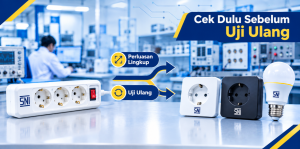
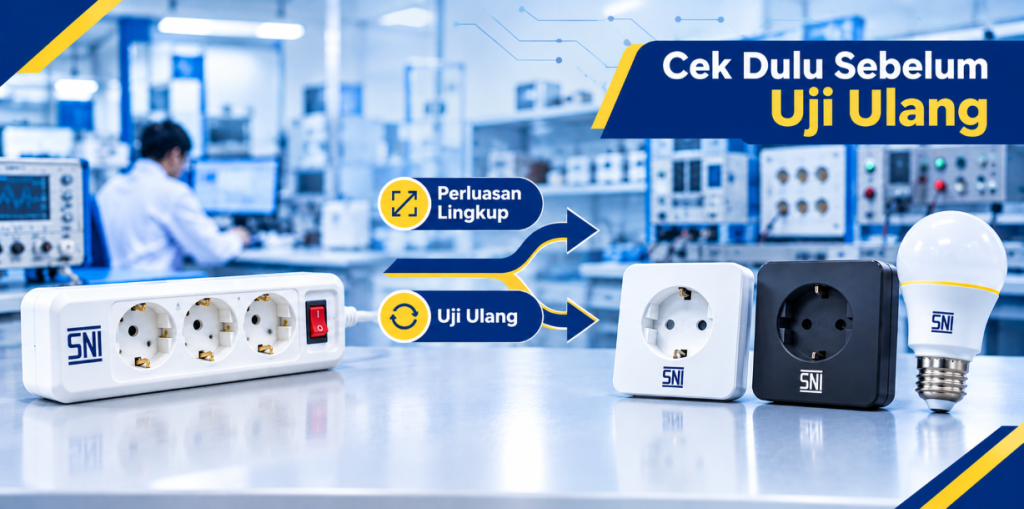
The answer isn't automatic. However, you don't necessarily have to start the entire process from scratch. Many certificate holders end up wasting time and money by choosing the wrong path. This article helps you determine when applying for an SNI certification extension is sufficient and when a new product requires retesting.
Why New Models Aren't Automatically Covered by Old Certificates?
The SNI Marking Product Certificate (SPPT-SNI) does not grant general permission for all your company's products. Instead, it binds to a specific product's identity. For example, the SPPT-SNI application document, which refers to the Minister of Industry's Regulation, lists the brand, type, class, and size of the product being applied for.
This means that every time you add a new type, change a brand, or change specifications, the product falls outside the scope of the certificate until it is assessed by LSPro. Therefore, selling a new model with the SNI logo from an old certificate risks violating the marking regulations.
Furthermore, electrical products have a strict legal basis. The Ministry of Energy and Mineral Resources emphasized that the purpose of implementing mandatory SNI (Indonesian National Standard) in the electricity sector is to meet electrical safety aspects as stipulated in Article 44 of Law Number 30 of 2009 concerning Electricity. In the context of the latest regulation, ESDM Ministerial Regulation No. 7 of 2021 revokes ESDM Ministerial Regulation No. 2/2018 and serves as the reference for implementing mandatory SNI for electricity. You can read the background to this regulatory simplification on the official website of the Ministry of Energy and Mineral Resources . ESDM Ruangenergi
What is the Expansion of the Scope of the SNI Certificate?
Scope extension is a mechanism that allows certificate holders to add products to an active certificate, without applying for a new certification from scratch.
In general, LSPro applies a similar pattern. For example, the Ministry of Industry's LSPro, BBSPJIA , explains that scope expansion can be carried out during the certification period, either concurrently with or outside of the surveillance schedule. Furthermore, the agency states that the validity period of revised certificates follows the validity period of the expanded certificate. BBSPJIA BBSPJIA
In other words, expanding the scope offers three main benefits. First, you don't have to repeat the entire audit of your production system and processes. Second, you can combine the schedule with surveillance for greater efficiency. Third, all your products remain under a single certificate, streamlining administration.
When is Scope Expansion Enough?
Scope expansion is generally the right choice if your changes don't affect the product's core safety and performance aspects. Some situations that typically fall into this category include:
Brand extension. You're marketing the exact same product under a new brand or a partner's brand. In this case, LSPro typically requests proof of the brand's legality. For example, an extension form at one LSPro requires a Trademark Certificate/Trademark Registration Certificate (if a brand is being added). ICP SURABAYA
Cosmetic changes. Variants only differ in color, pattern, or packaging design, while the materials, components, and internal construction remain the same.
Variants within a product family. New models remain within the same rating range and construction as the already tested type. In many IEC standards-based schemes, LSPro can assess design similarity and determine whether previous type test results are still representative.
Adding importers or distributors. The product is identical, but the distribution chain expands.
However, "simply expanding the scope" doesn't always mean no testing at all. Some LSPros still sample and test the product you're applying for, but without repeating all the initial certification steps. For example, the BBSPJIA states that as long as the surveillance cycle hasn't expired, expansion can be done simply by sampling and testing the product for which the SNI extension is being applied.
When Does a New Product Need Full Retesting?
On the other hand, there are changes that directly impact electrical safety. For these conditions, LSPro will almost certainly require comprehensive laboratory testing of the new model. Some examples:
Changes in electrical ratings. Increasing voltage, current, or power (e.g., increasing an LED light from 9 W to 18 W, or a wall outlet from 10 A to 16 A) changes the thermal and electrical loads on the product.
Critical component replacement. You replace the LED driver, capacitor, relay, insulation material, or terminal with a different supplier or specification.
Construction or material changes. The product housing changes from metal to plastic, the creepage distance changes, or the grounding design changes. Standards such as SNI IEC 60884-1 for plugs and socket outlets address these aspects in detail. You can find a summary in the LSPro IGS Electrical SNI article.
Added functionality. Products gain new features, such as USB ports on power outlets or motion sensors on luminaires.
Relocation of manufacturing plant or OEM supplier. A change in production location usually requires a new audit because LSPro must ensure process consistency across the facility.
Change of SNI edition. If the government implements a new standard edition, new models must comply with that edition, even if the old model was certified with the previous edition.
Summary Table: Scope Expansion vs. Retesting
| Type of Change | Common Path |
|---|---|
| Add brand, identical product | Scope expansion (document review) |
| Color or packaging variants | Expansion of scope |
| New model in one product family | Scope expansion + limited sample testing |
| Power, current, or voltage ratings change | Retest |
| Critical components or insulation materials change | Retest |
| Addition of new functions | Retest |
| Factory location changed | Audit and retest / new certification |
This table is only a preliminary guide. Ultimately, the final decision rests with LSPro based on the certification scheme, reference standards, and your product's technical data.
Documents You Need to Prepare
To ensure the process runs smoothly, please prepare the following documents before submitting your application:
- Application form for scope expansion from LSPro.
- Copy of valid SNI SPPT.
- Technical specifications of the new model, including a list of critical components and their suppliers.
- Technical drawings or internal photos of the product.
- Comparison table between old and new models.
- Proof of brand legality (if there are additional brands).
- Product label and marking design.
The fifth point is often overlooked, but comparison tables actually help LSPros quickly assess product similarity. The more clearly you show what changes and what remains the same, the more likely it is that LSPros will take a more concise approach.
Mistakes That Certificate Holders Often Make
Waiting for the recertification period. Some companies delay adding models until their certificates are nearly expired. As a result, new products sit in warehouses for months. However, you can apply for an extension at any time as long as the certificate is still valid.
Consider minor changes unnecessary to report. Changing internal cable suppliers may seem trivial, but these changes can impact test results. If regulatory authorities discover nonconformities in the marketplace, the risks far outweigh the cost of testing.
Submit models one at a time. If you're planning multiple variants per year, submit them simultaneously. This allows LSPro to develop a more efficient test program.
Consult Your Variant Plan Early
The most cost-effective approach is to discuss with the LSPro before the final product design. This way, your engineering team knows from the outset which changes are safe and which require retesting. You can even design variants to stay within the same product family.
LSPro IGS provides SNI certification for various electrical products, from electrical switches and plugs to LED lamps, luminaires, and fans . The institution was established in January 2013 and has obtained KAN accreditation with SNI ISO/IEC 17065:2012 requirements. If you are an importer, the LED lamp import guide and SNI certification are also relevant for plans to add imported models . Indonesian Electricity Indonesian Electricity
To understand the general certification process, you can also refer to the SNI certification process infographic from BSN and the LSPro IGS Product Certificate article.
Choose the Right Route, Save Time and Money
Adding a model or variant of an electrical product doesn't always require starting over from scratch. If the change only concerns the brand, appearance, or variant within a product family, expanding the scope of the SNI certificate is usually sufficient. Conversely, changes in ratings, critical components, construction, or production location almost always require retesting.
The key is thorough documentation and early communication with LSPro. So, before launching a new model, contact the LSPro IGS team to review the specifications and determine the fastest path to legal distribution for your product.