The History of SNI Textiles in Indonesia: From Voluntary to Mandatory
The textile and textile products (TPT) industry supports the national economy and touches everyone's basic needs, from baby clothes to hospital bedsheets. Therefore, the government continues to tighten its quality assurance through the Indonesian National Standard (SNI). Understanding the history of SNI textiles helps producers, importers, and consumers navigate the regulatory landscape, which is now rapidly moving from voluntary to mandatory implementation. This article traces this journey in detail, from the historical roots of standardization to the latest wave of regulations.
Understanding SNI and Its Position in the Textile Sector
The Indonesian National Standard (SNI) is the only standard applicable nationally. The National Standardization Agency (BSN) establishes SNI after a Technical Committee, together with representatives from producers, consumers, academics, and the government, formulates it. In the textile sector, SNI regulates various aspects of quality and safety, from fiber strength and colorfastness to sizing, to the content of hazardous chemicals such as carcinogenic azo dyes and formaldehyde.
SNI guarantees that products meet safety, security, health, and environmental preservation (K3L) requirements. This is the main reason the government is gradually moving some textile SNIs from voluntary to mandatory status.
The Historical Roots of Standardization in Indonesia
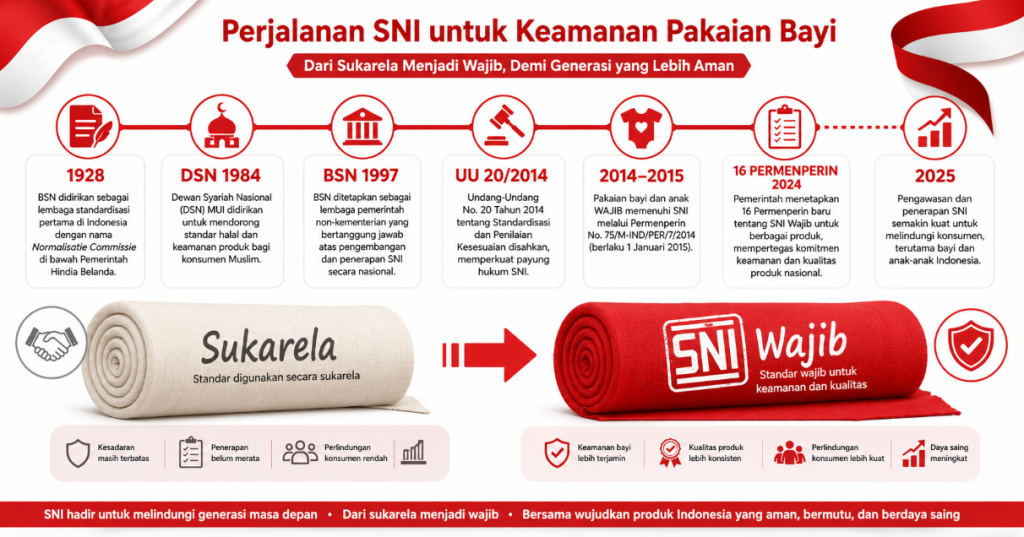
The history of SNI textiles is inextricably linked to the long history of national standardization. Indonesia began establishing standardization institutions in 1928, initially focusing on standards for building materials, transportation equipment, and electrical installations. In 1951, the government established the Indonesian Normalization Fund Foundation (YDNI), which later represented Indonesia in international organizations such as the IEC and ISO.
The government then set several important milestones: issuing Law No. 10 of 1961 (the Goods Law), making the development of a standardization system a priority program in 1973, and establishing the National Standardization Council (DSN) in 1984. It was through this DSN that the national standardization system that we know as SNI began to be born and develop.
The Birth of BSN and Strengthening Through Law 20/2014
The government dissolved the DSN on March 26, 1997, and established the National Standardization Agency (BSN) as its replacement, based on Presidential Decree No. 13 of 1997. This move unified standardization coordination, previously scattered across multiple ministries. The government strengthened its foundation through Government Regulation No. 102 of 2000 concerning National Standardization.
A major milestone emerged when the government passed Law No. 20 of 2014 concerning Standardization and Conformity Assessment on September 17, 2014. This law strengthened the role of the National Standardization Agency (BSN) and emphasized the goals of standardization: improving quality assurance, national competitiveness, and protecting consumers and the environment. This law serves as the legal umbrella for all SNI implementations, including in the textile sector.
Voluntary Principle: The Starting Point of SNI Textiles
Essentially, SNI is voluntary . The government designed SNI as a market reference for producers to independently improve quality. For years, most textile SNIs—such as standards for woven fabrics, towels, socks, bedsheets, and even ready-to-wear clothing—were voluntary.
Manufacturers seeking to demonstrate product quality apply for independent certification and have their products tested in accredited laboratories. This approach provides flexibility for the industry, but it also poses a drawback: consumers find it difficult to distinguish quality products from cheap counterparts, while market oversight remains lax.
Transition to Mandatory: Baby Clothes Take the Lead
Law 20/2014 (Article 24) and Government Regulation No. 34 of 2018 (Article 25) authorize the government to enforce certain SNIs as mandatory through technical regulations. The government exercises this authority when a product concerns safety, health, national security, or environmental preservation. Once an SNI is made mandatory, products that do not comply are prohibited from being distributed.
In the textile sector, the government first implemented mandatory SNI for baby clothing . The Ministry of Industry issued Ministerial Regulation No. 7/M-IND/PER/2/2014 and its amendment No. 97/M-IND/PER/11/2015. This regulation requires fabrics for baby clothing to meet SNI 7617, which prohibits the content of carcinogenic azo dyes and limits the levels of formaldehyde and extracted metals. The government chose baby clothing as a pioneer because babies' skin is very sensitive and prone to irritation.
Since then, product certification bodies (LSPro) have played a key role in verifying compliance with these standards. You can learn more about the SNI requirements and certification process for baby clothing, which refer to this mandatory SNI.
New Wave: 16 Ministerial Regulations and the Push for SNI for Ready-to-Wear Apparel
For nearly a decade, the only SNI for textiles that was mandatory was for baby clothing. The industry noted that dozens of other SNIs for textiles were still voluntary. This situation began to change in October 2024, when the Ministry of Industry issued 16 Ministerial Regulations concerning the mandatory implementation of industrial standardization. Since that period, the Ministry of Industry has implemented approximately 130 mandatory SNIs for products with significant impacts on the Health, Safety, and Environment (K3L). The government asserts that this policy aims to curb the flood of illegal imports while protecting consumers.
Pressure to expand the scope of mandatory SNI for textiles continues to grow. Throughout 2025, various parties—including consumer associations and members of the House of Representatives—are pushing the government to make SNI mandatory for all fabric and apparel products, rather than simply voluntary. They believe this will protect consumers from low-quality products and protect local industries from the influx of illegal secondhand clothing. The government has also designated apparel production as a medium-high-risk business activity through Government Regulation No. 28 of 2025, requiring businesses to obtain a Standard Certificate.
This policy direction shows one thing clearly: SNI textiles are moving consistently from voluntary to mandatory, and their scope will continue to expand.
Impact on Industry and Consumers
The shift to mandatory SNI has real consequences. For producers and importers, this obligation requires product certification, registration through official systems such as SIINas and OSS, and routine testing in laboratories accredited by the National Accreditation Committee (KAN). For consumers, this policy promises safer products with measurable quality.
Industries that prepare early will adapt more easily. Manufacturers should map their products, ensure raw materials are free of hazardous substances, and collaborate with testing agencies early on. You can explore the scope of textile standardization at the Textile Industry Standardization and Services Center (BBSPJI) to understand the list of products covered.
The Role of Certification Bodies in Fulfilling SNI Textiles
Every SNI implementation requires proof of conformity, and that proof comes from accurate laboratory testing and valid certification. Accredited laboratories test critical parameters such as azo dye content, formaldehyde levels, extracted metals, tensile strength, and color fastness. Once a product passes the test, the product certification body issues a Product Certificate for Use of the SNI Mark (SPPT SNI) as official proof of compliance. Without this certificate, manufacturers cannot display the SNI mark or legally distribute their products.
This is where the role of certification partners becomes crucial. LSPro IGS is present as a KAN-accredited product certification body and supports the industry in meeting SNI textile requirements. LSPro IGS assists with the SNI certification process for baby clothing and other textile products, explaining practical steps through a guide on how to manage SNI . Manufacturers and importers who want to ensure their products pass certification can utilize SNI management services from the development stage, with testing conducted in accredited laboratories of IGS partners.
Closing Event
The history of SNI textiles in Indonesia shows a logical and directed journey. The government started with the foundation of standardization in 1928, strengthened it through the establishment of the National Standardization Agency (BSN) and Law 20/2014, and then implemented SNI voluntarily as a quality reference. Baby clothing entered the mandatory SNI phase in 2014–2015, and the 2024–2025 wave of regulations expanded its scope to include more textile products.
For industry players, the message is simple: preparing for compliance early is far wiser than rushing in when regulations require it. Start by understanding the standards that apply to your product, then ensure every parameter is tested in an accredited laboratory. That way, you not only comply with regulations, but also build consumer confidence in the quality of your product.