Differences between SPPT SNI and SKEM, K3L & Postel Certificates
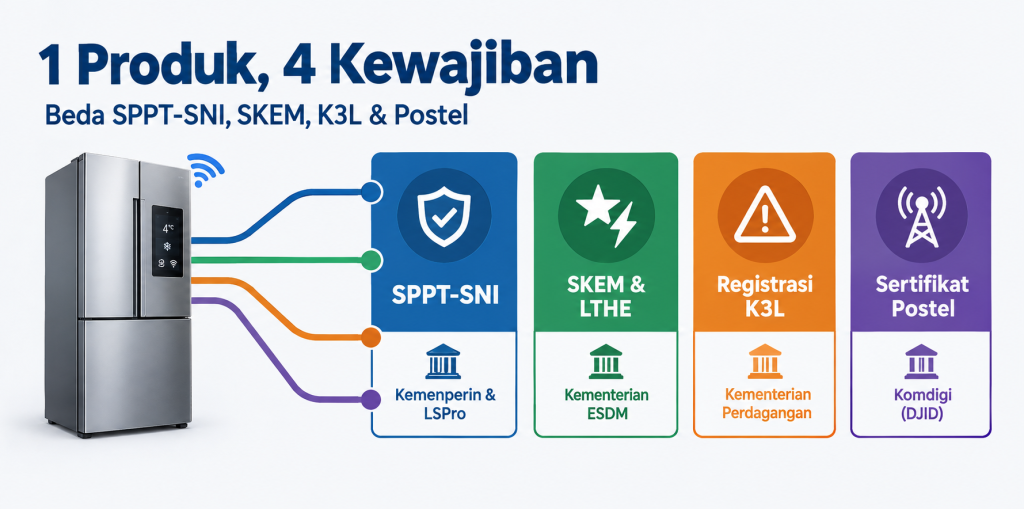
An importer ordered 500 smart refrigerators from China. He already had the SPPT-SNI certification, so he was confident the legalities were in order. However, the goods were held up. Officials asked for the energy-saving label and the telecommunications equipment certificate. He finally realized that a single product could be carrying four obligations simultaneously.
Cases like this occur almost every month. The root of the problem is simple: many business owners assume the four documents are interchangeable. However, this assumption is incorrect, as the four ministries handle four different aspects of the same product.
This article outlines the differences between SPPT SNI and SKEM , plus two other frequently overlooked requirements: K3L Registration and Postal and Telecommunication Certificates. Consider it a complement to our previously published guide to importing electrical products and SNI requirements . Therefore, its purpose is to help you determine what documentation your product requires before the container departs.
Why Can One Product Be Subject to Four Regulations?
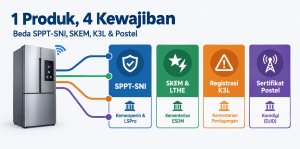
The government doesn't divide regulations based on the type of product. Instead, it divides them based on the risks they monitor . A single smart refrigerator carries four distinct risks:
| Risks | Supervisor | Instruments |
|---|---|---|
| Electric shock, fire, low quality | Ministry of Industry & BSN | SPPT-SNI (+ NPB) |
| Wasteful electricity | Ministry of Energy and Mineral Resources | SKEM & LTHE |
| Consumer dangers of products without mandatory SNI | Ministry Trading | K3L Registration |
| Radio frequency interference | Komdigi (DJID) | Postal Certificate |
Four institutions. Four perspectives. One product. Therefore, one certificate never cancels out the obligations of another.
Quick Comparison Table
| Aspect | SPPT-SNI | SCHEME / LTHE | K3L Registration | Postal Certificate |
|---|---|---|---|---|
| agency | LSPro is accredited by KAN; NPB from the Directorate General of PKTN, Ministry of Trade | Directorate General of EBTKE, Ministry of Energy and Mineral Resources | Directorate General of PKTN, Ministry of Trade | Directorate General of Digital Infrastructure (DJID), Komdigi |
| What is measured | Product safety and quality | Energy consumption | Basic security parameters | Radio technical standards |
| Main principle | Law 20/2014, PP 34/2018, Minister of Trade Regulation 33/2025 | ESDM Ministerial Regulation 14/2021 | PP 29/2021, Permendag 33/2025 | Minister of Communication and Information Regulation 3/2024, PP 46/2021 |
| Form of assessment | Lab test + factory audit | Energy performance testing in an accredited lab | Lab test + self-declaration (SDoC) | Technical standard lab test |
| output | Certificate + SNI mark + NPB | Energy saving certificate + LTHE listing permit | K3L registration number | Certificate + certificate number label |
| Marks on the product | SNI + NPB Logo | 1–4 star labels | K3L number on goods/packaging | Certificate number + PLG code |
| Quality | Mandatory for SNI products | Mandatory for specified equipment | Required for 42 items in the attachment | Mandatory for telecommunication enabled devices |
See also:
1. SPPT-SNI: Proof of Safe and Quality Products
SPPT-SNI is a Product Certificate for the Use of the SNI Mark. In other words, this certificate grants you the right to affix the SNI logo to products.
Who issues them? Product Certification Institutions (LSPro) appointed by the National Accreditation Committee (KAN) and technical ministries. You can check the accreditation status of each LSPro directly on the KAN website, while a list of mandatory SNIs and designated LSPros is available on the Ministry of Industry's Standardization Center portal.
What do they check? Two things. First, laboratory test results on product samples. Second, an audit of the quality management system at the manufacturing plant. For imported products , auditors typically fly to the overseas factory. You can find an overview of the steps in the factory audit guide until the certificate is issued.
Examples of affected electronic products include electric irons , water pumps , fans, washing machines, refrigerators, air conditioners, televisions, electrical cables , ballasted lamps , and switches. A complete list of the scopes we cover can be found on the LSPro IGS electronics product certification page.
Don't Forget NPB
Many importers stop at the SPPT-SNI certification process, even though there's still one more step.
The Goods Registration Number (NPB) identifies domestically produced or imported goods that meet SNI and/or mandatory technical requirements. The NPB must be displayed on the goods and/or packaging before the product enters the market. Furthermore, for importers, the NPB must also be included in the Import Notification (PIB).
This is what it means. The SPPT-SNI (Standardized National Certification) proves your product meets standards. The NPB (National Certification Body) registers the product with the Ministry of Trade so it can enter customs. The NPB application is then processed through the Ministry of Trade's SIMPKTN portal , with a maximum processing time of three business days upon receipt of complete and accurate documents.
So without an NPB, your SPPT-SNI is useless at Customs and Excise. The Directorate General of PKTN also summarizes technical questions about registration on the NPB FAQ page.
2. SKEM and LTHE: Evidence of Energy-Saving Products
SKEM stands for Minimum Energy Performance Standard. The regulation was issued by the Minister of Energy and Mineral Resources Regulation No. 14 of 2021, issued on June 22, 2021, revoking Ministerial Regulation No. 18/2014 and Ministerial Regulation No. 57/2017.
Essentially, ESDM Ministerial Regulation 14/2021 requires domestic producers and importers to implement the SKEM (Energy Savings Mark) on energy-utilizing equipment they sell in Indonesia. This is implemented through the inclusion of the SKEM mark or the affixing of an Energy Savings Label (LTHE), in accordance with the Ministerial Decree for each type of equipment.
What does it look like? A star sticker. The energy-saving level is indicated by the number of stars with a specific value. Four stars means the most efficient. Conversely, one star means it just passes the minimum threshold.
What products? The government is implementing it in stages. It started with air conditioners, then expanded to refrigerators, fans, rice cookers, LED lights, refrigerated display cases (showcases), televisions, and water dispensers. The next target is eleven appliances by 2030, including washing machines, irons, and water pumps.
What's the process? LSPro tests the product's energy performance and then issues an Energy Saving Certificate (SHE). The Directorate General of New, Renewable Energy (EBTKE) summarizes the specific process for importers on the Ministry of Energy and Mineral Resources' (ESDM) SKEM and LTHE portals . After that, you apply for a permit to list the LTHE with the Director General of New, Renewable Energy (EBTKE). Only after the permit is issued can you affix the star label.
The Difference Between SPPT SNI and SKEM: This is the Core of the Confusion
This is the part that importers most often stumble over. Both use testing laboratories, involve LSPro, and produce product markings. However, they answer completely different questions.
SPPT-SNI answers: Is this product safe and of high quality? The focus is on safety. Electrical insulation, material durability, surface temperature, leakage current, and construction strength are all factors.
SKEM answers: Is this product energy efficient? The focus is on efficiency. Power consumption per unit of output, energy efficiency ratio, and annual consumption.
Three practical differences you need to note:
- Different ministries. The SPPT-SNI process goes to the Ministry of Industry and the Ministry of Trade. The SKEM process goes to the Ministry of Energy and Mineral Resources. Two separate bureaucratic channels, two separate application systems.
- Test reports cannot be used interchangeably. The SNI safety test report does not include energy consumption data, while the SKEM test report does not include leakage current data. Therefore, you need two tests.
- Passing SNI does not mean passing SKEM. An air conditioner can be perfectly safe but incredibly wasteful. The product may pass SNI standards but fail to meet the SKEM threshold.
A split AC unit may require an SPPT-SNI (Indonesian National Standardization Certificate), a National Energy Registration Number (NPB), an energy-saving certificate, and an LTHE permit. If the unit has Wi-Fi, an additional Postal and Telecommunications Certificate is required. This totals five documents for one product.
3. K3L Registration: Safety Net for Products Without Mandatory SNI
K3L registration protects consumers from products that are not yet on the mandatory SNI list but still pose risks. K3L stands for Security, Safety, Health, and the Environment.
Minister of Trade Regulation Number 33 of 2025 lists 42 K3L-related goods, including 20 containing hazardous chemicals and 22 electrical and electronic goods, that are required to have an K3L Goods Registration Number. This requirement applies to both domestic and imported products, and producers or importers must apply for one before the goods are distributed to the market. The list of goods, safety requirements, and testing methods are listed in Appendix III of the regulation.
The main requirements are: a self-declaration of conformity, laboratory test results that include the brand and type of goods and must be issued no later than six months before the submission date, as well as a list and addresses of distributors, agents, wholesalers or retailers.
After the number is issued, producers or importers are required to include the K3L registration number on goods, packaging, and/or labels in a legible and durable manner. Re-registration is then required every five years to update the data.
Consider the logic. K3L and mandatory SNI generally don't overlap for the same product. If your product is already on the mandatory SNI list, your path is SPPT-SNI plus NPB. Conversely, if not, check the K3L list. A classic importer mistake is applying for K3L for a product that actually requires mandatory SNI.
4. Postel Certificate: Permit to Transmit Signals
The Postel Certificate regulates devices that transmit or receive radio waves. Previously known as the SDPPI certification, the application process is through the NextGen e-Certification system.
An important note regarding the agency's name. The Directorate General of Postal and Informatics Resources and Equipment (SDPPI) was renamed the Directorate General of Digital Infrastructure (DJID) on February 7, 2025, in line with the transformation of the Ministry of Communication and Information Technology (Kominfo) into the Ministry of Communication and Digital (Komdigi). Meanwhile, existing certificates issued under SDPPI's name remain valid until they expire.
What products are affected? According to Ministerial Regulation No. 3 of 2024, the categories include mobile devices such as cell phones and tablets, network devices such as routers and access points, short-range devices such as Bluetooth speakers and TWS, and IoT devices such as smart meters and smart home appliances. Furthermore, Ministerial Decree No. 469 of 2025 stipulates a list of telecommunications equipment and devices with telecommunications features that must meet technical standards. Details of the document requirements are available on the telecommunications equipment and device certification service page.
The validity period is unique. According to Article 18 of Ministerial Regulation 3/2024 of the Ministry of Communication and Information, certificates are not time-limited. However, certificate holders may only manufacture, assemble, or import devices for commercial use for a maximum of three years from the date of issuance. After that period, the device must meet technical standards based on new test results, evidenced by a new certificate.
So the certificate is perpetual, but the import rights are valid for three years. In fact, many importers misread this point.
Case Study: Mapping Four Real Products
Smart refrigerator with Wi-Fi SPPT-SNI + NPB (safety), SKEM + LTHE (efficiency), Postel Certificate (Wi-Fi module). K3L is not applicable because the product has already met the mandatory SNI. Total: three lines, four documents.
Portable Bluetooth speakers require a Postal and Telecommunications Certificate. Also, check the K3L list for electrical and electronic products. Meanwhile, the SKEM (Emergency Management Standard) does not apply, as the mandatory SNI does not yet cover this category.
A regular electric iron meets SPPT-SNI + NPB standards. It lacks a radio feature, so Postel (Postal Telecommunication) is not applicable. SKEM (Electricity and Telecommunications Standard) is not yet applicable to irons, although it is included in the 2030 target.
SPPT-SNI LED lights + NPB for safety, plus SKEM and LTHE for efficiency. So, two paths at once. We discuss the background in the article "From SNI LED to Mandatory SNI ."
Five Questions to Determine Your Product Liability
Please run this sequence before you order the item:
- Is my product on the mandatory SNI list? Check the Attachment to Permendag 33/2025 at JDIH Ministry of Trade and list of mandatory SNI from the Ministry of IndustryIf yes, prepare SPPT-SNI and NPB.
- Is my product included in the list of energy utilization equipment with SKEM? Check list of regulations of the Directorate General of EBTKE for your equipment type. If so, prepare an energy saving certificate and LTHE permit.
- Does my product emit radio waves? Wi-Fi, Bluetooth, cellular, NFC, RFID, or wireless remote. If yes, prepare the Postel Certificate via NextGen e-Certification.
- If a product does not comply with the mandatory SNI, is it included in the 42 K3L items? Check Attachment III of Permendag 33/2025. If so, prepare the K3L Registration.
- Does my HS Code require Import Approval or Surveyor Report? This is the fifth layer which is outside the four obligations mentioned above, but is the same as holding goods at the port.
Efficient Order of Management
Don't handle all four randomly. This order saves time and money:
- Determine the HS Code and verify the list of obligations. Because a wrong HS Code means the entire map is wrong.
- Make sure your NIB and KBLI are correct. Because all applications are processed through OSS.
- Send samples for parallel testing. Safety tests, energy tests, and radio tests can run concurrently in different laboratories.
- Run factory audit for SPPT-SNI. This is the longest stage, usually taking the longest time in the chain.
- Apply for certificate and registration. SPPT-SNI then NPB, energy saving certificate then LTHE, Postel, and K3L permits if relevant.
- Print labels after all numbers are issued. Therefore, don't print the packaging first. The NPB, K3L, and Postel numbers must appear on the product or packaging.
The Five Most Common Mistakes
- Thinking that SPPT-SNI covers everything. The certificate only addresses the safety aspect.
- Stop at SPPT-SNI without taking care of NPB. Customs checks the NPB, not just the certificate.
- Manage K3L for products that require mandatory SNI. Because these two paths are not interchangeable, and the wrong choice can waste months of time.
- Forgetting the Wi-Fi module on household appliances. Smart refrigerators, smart air conditioners, and smart washing machines still require Postel Certificates.
- Print the packaging before the registration number is issued. In fact, the cost of reprinting often exceeds the cost of the certification itself.
The Risk If You Ignore It
The consequences are multi-level. First, Customs can detain goods at the port, while demurrage accrues daily. Next, the government can order re-exportation or destruction, with the costs falling on the business owner. The Ministry of Trade can also suspend trading activities and withdraw goods from circulation. Registration numbers can even be revoked.
Simple math. For example, a 40-foot container held for two months could cost tens of millions of rupiah in demurrage and storage alone. That figure typically far exceeds the certification costs you've avoided.
Frequently Asked Questions
Can SPPT-SNI replace SKEM? No, because they measure different parameters and originate from different ministries.
Do I need K3L if a product already has mandatory SNI certification? Generally, no. K3L targets products that are not yet on the mandatory SNI list. Always check the latest list, as the scope of both changes over time.
Does a laptop need a Postel Certificate? Yes, if the laptop has Wi-Fi or Bluetooth. In fact, almost all modern laptops have them.
How long does the total process take? It depends on the factory's readiness and the laboratory's waiting list. Therefore, plan for several months, not weeks. The factory audit for SPPT-SNI usually determines the schedule.
Can a certificate from the country of origin be used? Generally, not directly. Some test reports from foreign laboratories can be accepted through the MRA scheme, but the certificate must still be issued in Indonesia.
Official Sources and References
Save the following link as your working reference:
| Needs | Official source |
|---|---|
| List of mandatory SNI and designated LSPro | Ministry of Industry Standardization Center |
| LSPro and testing laboratory accreditation status | National Accreditation Committee (KAN) |
| Information on SNI standards and SPPT | National Standardization Body (BSN) |
| NPB registration and services of the Directorate General of PKTN | Ministry of Trade's SIMPKTN |
| NPB and K3L technical questions and answers | FAQ of the Directorate General of PKTN |
| Manuscript of Minister of Trade Regulation 33/2025 | JDIH Ministry of Trade |
| SKEM and LTHE flow for importers | Portal of SKEM Directorate General of EBTKE |
| ESDM Ministerial Decree per type of equipment | Regulation of the Directorate General of EBTKE |
| Background of SKEM application in AC | News from the Directorate General of EBTKE |
| Postal and Telecommunication Certificate Application | NextGen e-Certification, DJID Komdigi |
| Device certification document requirements | Telecommunication Equipment and Device Certification Services |
Four Documents, Four Different Questions
In short, these four obligations are not interchangeable, as each addresses different questions about the same product. The SPPT-SNI addresses safety. The SKEM addresses efficiency. The K3L addresses consumer protection. Postel addresses frequency.
Map out your product obligations before you pay the down payment to the factory, not after the container docks at Tanjung Priok. The time difference determines whether you trade or pay a fine.
If you're still unsure which products go where, the LSPro IGS team is ready to help map them out before you lock in a contract with a factory.
Regulatory note. This article uses references valid as of September 2026. The list of products requiring SNI, K3L goods, SKEM equipment, and devices requiring certification changes periodically. Always verify with official sources: JDIH Kemendag , Ditjen EBTKE , SIMPKTN , and Komdigi e-Certification.