How to Verify SNI Certificates for Baby Clothes for Buyers
For buyers and procurement teams in modern retail, a single piece of baby clothing that makes it onto store shelves carries legal consequences far greater than its purchase price. Baby clothing is one of the products required to have SNI certification in Indonesia. This means that once a product without a valid certificate enters your distribution network, the risk of recalls, administrative sanctions, and even reputational damage is no longer solely the responsibility of the supplier but also the retailer that distributes it.
The problem is, in the field, certificate verification often stops at "the supplier sends a PDF of the certificate, then it's filed . " However, certificates can expire, be revoked, have a scope that doesn't match the product, or even never actually be registered. This article discusses how to independently and structuredly verify the validity of SNI certificates for baby clothing—specifically for the needs of modern trade chains like Hypermart, Toys Kingdom, and similar retail chains.
Why SNI Verification Is Procurement's Responsibility, Not Just Suppliers'
The legal basis for the implementation of mandatory SNI for baby clothing is the Minister of Industry Regulation No. 07/M-IND/PER/2/2014 concerning the implementation of SNI requirements for azo dyes, formaldehyde levels, and extracted metal levels in fabrics for baby clothing. The technical standard used as a reference is SNI 7617:2013 and its amendments (Amd1:2014). Meanwhile, PP No. 34 of 2018 concerning the National Standardization and Conformity Assessment System regulates the national standardization system.
The scope of products affected by this obligation is quite broad: ready-to-wear clothing for babies up to 36 months old that comes into direct contact with the skin—from tops, bottoms, overalls, underwear, and jackets, to accessories such as head coverings, bibs, gloves, socks, swaddles, diapers, and octopuses. Many buyers mistakenly assume "it's just a baby hat" or "it's just socks" and thus escape inspection. However, these small items still fall within the scope of mandatory SNI.
For retailers, the consequences of distributing products without valid SNI certification are not theoretical. The government regularly monitors goods in circulation, and when inspectors find problematic products on shelves, they are most likely to reach retailers. Therefore, procurement verification serves as the last line of defense before products reach the most vulnerable consumers: babies.
Anatomy of a Valid SNI Certificate for Baby Clothes
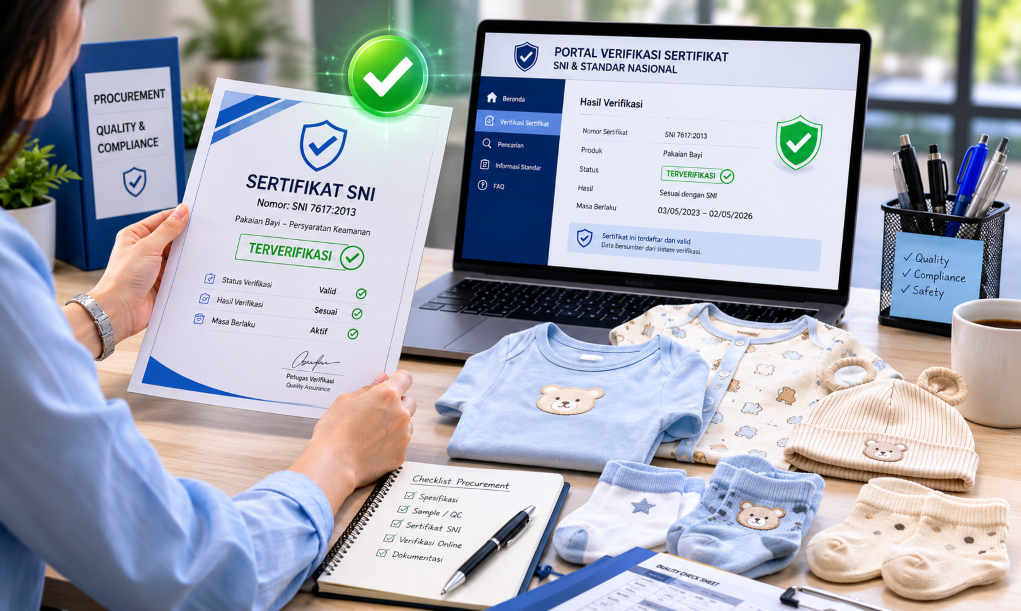
Before verifying authenticity, the buyer team needs to know what the correct documentation looks like. The mandatory SNI certification for baby clothing generally takes the form of a Certificate of Conformity , which serves as the basis for the use of the SNI Mark (industry circles commonly call it SPPT-SNI, or Letter/Certificate of Approval for Use of the SNI Mark). A valid document should contain at least:
- Name and accreditation number of the Product Certification Institute (LSPro) publisher, in a format such as
LSPr-XXX-IDN. LSPro is the one that issues the certificate, not the factory or importer. - Standard reference, namely SNI 7617:2013/Amd1:2014, complete with the certification scheme used (for mandatory SNI for baby clothes, usually Scheme/Type 1b).
- Identity of the certificate holder: company name, brand (Italian and international brands), and the types of products covered.
- Validity period certificate and date of issue.
- Compliance mark and references to guidelines SNI ISO/IEC 17065, which is the standard for product certification bodies.
If the supplier's submitted documents don't include the LSPro name and accreditation number, consider this a first warning to halt the process and request clarification. For a complete overview of the tested parameters and the issuance process, the SNI Baby Clothing reference page from LSPro IGS can be your team's first point of reference.
Four Steps to Self-Verification for Procurement Teams
Proper verification isn't simply about "seeing the SNI logo." Here's a four-step process that your team can use as a standard operating procedure (SOP) for accepting new suppliers or reorders.
Step 1 — Read and Match the Contents of the Certificate Document
Start with the simplest but most often overlooked point: is the product listed on the certificate exactly the same as the one you're planning to buy? Check the brand, product type, and material description. A certificate for "Brand A baby underwear" doesn't automatically apply to "Brand A baby blanket" or to other brands from the same manufacturer. Also, check the expiration date—an expired certificate should not be used as a basis for accepting goods.
Step 2 — Ensure the Publisher's LSPro is KAN Accredited and Appropriate for the Scope
A certificate is only valid if the LSPro is accredited by the National Accreditation Committee (KAN) for the scope of baby clothing, and—for mandatory SNI— the Ministry of Industry also appoints the LSPro. You can check the accreditation status of an LSPro through the official KAN directory at kan.or.id. Look for the name of the institution or its accreditation number, then ensure the listed scope actually includes “Baby Clothing.” An LSPro accredited for electrical or food products, for example, is not authorized to issue baby clothing certificates.
Step 3 — Verify the Certificate in the BANG BENI BSN System
This is a key step that buyers rarely take. The National Standardization Agency (BSN) provides a public information system, SI BANG BENI (SNI Goods Information System), to verify whether products are actually registered with SNI certification. Access it at bangbeni.bsn.go.id/barang-ber-sni , then enter the certificate number, product name, brand, or company name in the search field.
If the certificate is valid and registered, the system will display complete product details, including the issuance and expiration dates . Ensure two things: first, that the displayed data matches the physical documents from the supplier; and second, that the validity period is still active when the goods are received. If you don't find the certificate number in the system, that's a serious red flag and needs to be confirmed before issuing a purchase order.
Step 4 — Check the SNI Marking and Product Registration Number (NPB) on the Product
The final verification goes back to the physical goods. SNI-mandated products must bear the SNI Mark on their product or packaging, and for SNI-mandated products, it is generally also associated with a Goods Registration Number (NPB) that the importer registers through the OSS system. Check whether the marking on the product sample is consistent with the identity on the certificate and in the BANG BENI system. For the SNI 7617:2013 standard document itself, you can search for it in the Standardization and Conformity Assessment Information System (SISPK) at sispk.bsn.go.id.
Special Notes for Imported Products
Most baby clothes in modern retail are imported. For imported products, the applicable system requires a designated laboratory to conduct sampling and testing on each import—officers take samples from the importer/manufacturer's warehouse and then have the laboratory test them. The implication for buyers : don't accept one old certificate to justify multiple import shipments. Ask the importing supplier to show the certificate relevant to the batch/import you received. A more complete discussion of this requirement is available in the article " Importing Baby Clothes from LSPro IGS . "
SNI Verification Checklist for Buyer
Use the following table as an appendix to your supplier acceptance SOP. A product is only eligible for acceptance if all points are verified.
| No | Verification Item | Check Source | Status |
|---|---|---|---|
| 1 | Product & brand on certificate matches PO | Certificate document | ☐ |
| 2 | Standard reference = SNI 7617:2013/Amd1:2014 | Certificate document | ☐ |
| 3 | The certificate is still valid | Documents + BANG BENI | ☐ |
| 4 | LSPro is accredited by KAN & scope is “Baby Clothing” | kan.or.id | ☐ |
| 5 | Registered & valid certificate number | bangbeni.bsn.go.id | ☐ |
| 6 | The SNI mark is printed on the product/packaging | Physical samples | ☐ |
| 7 | Registered NPB (for SNI mandatory products) | OSS / documents | ☐ |
| 8 | For imports: certificates according to the relevant imports | Import documents | ☐ |
Red Flags to Watch Out For
Some patterns that should prompt further investigation include: the certificate number is missing from BANG BENI; the issuing LSPro is missing from the KAN directory or its scope does not include baby clothing; the product brand/type on the certificate differs from the actual product; the supplier is still using an expired certificate for new shipments; and the SNI logo lacks a certificate number or LSPro reference that you can track. Anyone can easily reprint the SNI logo—but no one can fake its digital footprint in the official BSN and KAN systems. Therefore, digital verification always trumps visual verification.
When in Doubt, Confirm Directly with LSPro Publisher
If, after the four steps above, there are still doubts—for example, if the data at BANG BENI is not up to date or if the document seems odd—the most appropriate step is to confirm the certificate's authenticity directly with the LSPro named on the certificate. Credible certification bodies will be happy to confirm the status of the certificates they issue. For example, LSPro IGS (PT Integrita Global Sertifikasi) is a KAN-accredited product certification body that handles SNI certification for baby clothing and can serve as a point of confirmation and technical reference for the procurement team. To understand the supplier side—including testing parameters and the issuance process—your team can read How to Manage SNI for Baby Clothing and why manufacturers are required to have SNI certification.
Frequently Asked Questions (FAQ)
Is seeing the SNI logo on the packaging enough to validate a product? No. Anyone can print the SNI logo. You can only verify its validity by matching the certificate number in the BANG BENI BSN system with the LSPro accreditation status at KAN.
What if the supplier only sends a photo of the certificate? Request an official PDF copy complete with the certificate number, then verify it yourself at bangbeni.bsn.go.id. Do not use the photo as final proof.
Is one certificate valid for all of a supplier's product variants? No. Certificates are tied to specific brands and product types. New variants or brands require a re-match to the certificate's scope.
Who is responsible if a product without SNI certification makes it to shelves? The responsibility can extend to the retailer, as the party distributing the goods. Therefore, procurement verification protects your business.
Closing Event
Verification of SNI certification for baby clothing is not an administrative formality, but rather a risk control measure that protects both retailers and the most vulnerable consumers. By incorporating four steps—document verification, LSPro accreditation verification at KAN, verification at BANG BENI, and product labeling—into the supplier acceptance standard operating procedure (SOP), the buyer team can ensure that every piece of baby clothing entering the shelves truly meets national safety standards. If you need technical confirmation or further guidance, LSPro IGS is ready to be your procurement team's verification partner.